AI
6
Minutes to Read

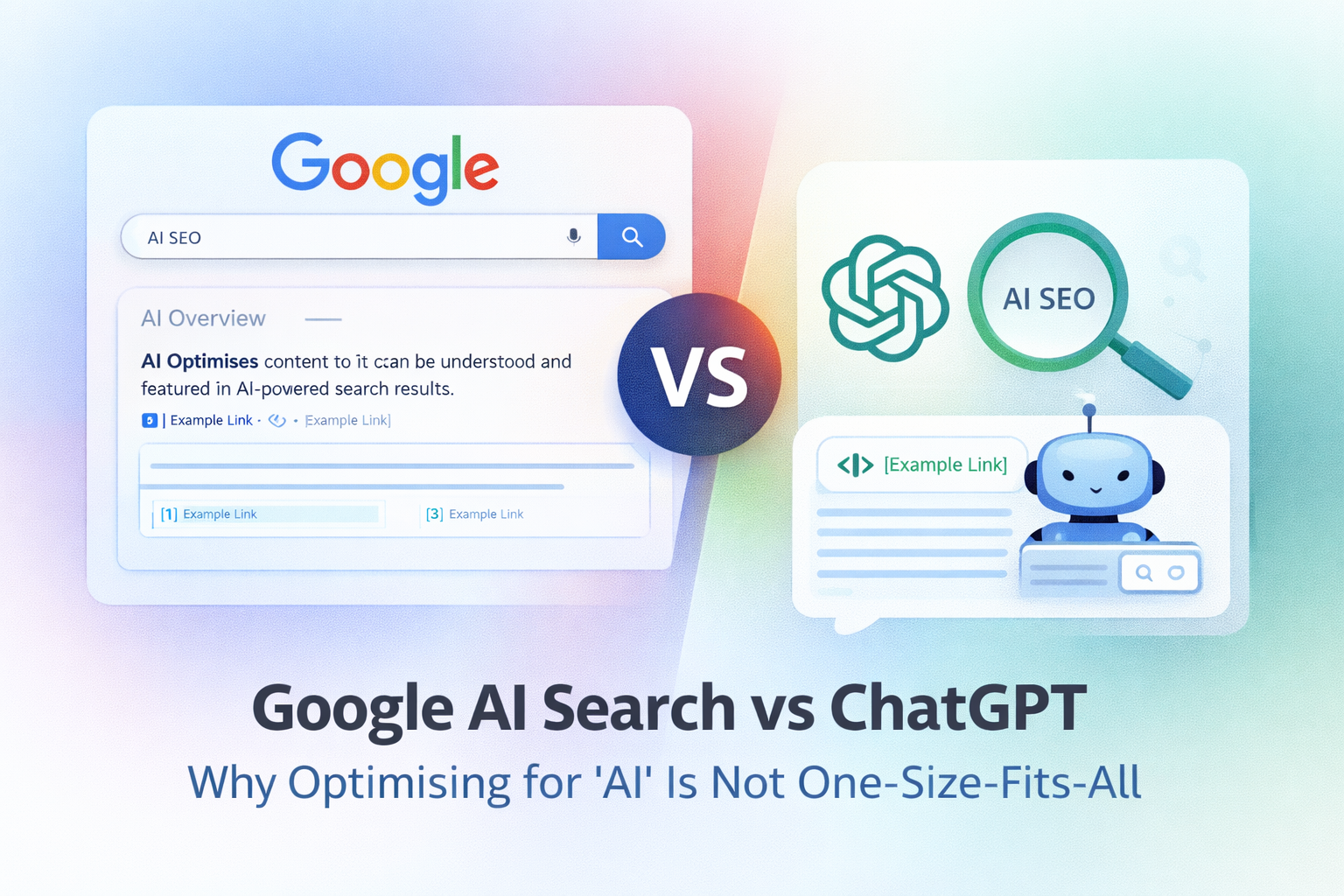
Google AI Search vs ChatGPT: Why Optimising for ‘AI’ Is Not One Size Fits All

The #1 AI Mistake Businesses Are Making

Right now, most businesses are lumping everything into one bucket called “AI”.

They assume:

  • Google’s AI in Search
  • ChatGPT
  • Perplexity
  • Bing Copilot
  • and every “AI answer” interface

…all work the same way. They don’t - and if your strategy is “optimise for AI” without specifying which AI system, you’ll end up doing the wrong work, measuring the wrong outcomes, and expecting the wrong results.

This guide breaks down:

  • What Google AI in Search actually is (and how it decides what to show)
  • What ChatGPT is
  • Why ranking in ChatGPT is not the same goal as appearing in Google AI Overviews
  • What to optimise for in each ecosystem

First, lets define what Google AI actually means

When people say Google AI search, they’re usually talking about AI features inside Google Search, especially AI Overviews (Google’s generative summaries shown in results). Google has an official Search Central guide explaining how AI features (including AI Overviews) relate to websites and inclusion.
Google also announced the rollout of AI Overviews and associated generative search experiences publicly.

Google AI Overviews are not a separate product from Google Search, they’re a SERP feature, fed by Google’s search systems and web index.

That means Google’s AI output is shaped by:

  • Indexing (what Google can crawl)
  • Retrieval (what pages it can fetch for the query)
  • Ranking systems (what it thinks is relevant/credible)
  • Safety/quality policies (especially in sensitive areas)

What ChatGPT is (and why it behaves differently)

ChatGPT is a conversational AI model. It can answer from it's trained knowledge, or live web search, depending on product settings and what you ask.

OpenAI describes ChatGPT Search as a way for ChatGPT to browse the web and provide answers with links. OpenAI’s help docs also note that when ChatGPT uses search, it includes inline citations/sources.

ChatGPT does not “rank” websites like Google does.
Even when it cites sources, it’s not running Google’s ranking algorithm. It’s generating a response in a conversational interface, optionally grounded in retrieved pages.

The real difference in one line

  • Google AI is built on top of a search engine that retrieves and ranks pages.
  • ChatGPT is a language model that generates answers, and may optionally retrieve sources.

Google AI Search: what happens under the hood

You don’t need to be an engineer to understand.

Step 1: Google interprets the query (intent + context)

Google processes the query and tries to infer intent:

  • Informational (“what is…”, “how does…”, “why…”)
  • Commercial investigation (“best…”, “top…”, “compare…”)
  • Transactional (“buy…”, “book…”)
  • Navigational (“brand name + login/pricing”)

Context can include location/language/device, and the result format can change accordingly.

Step 2: Retrieval from Google’s index

Google pulls candidate pages from its index. If you’re not indexed properly, you don’t exist for this layer.

Step 3: Ranking + selection

Even for AI Overviews, Google still needs to decide which sources are trustworthy enough to base a summary on.

Step 4: The AI Overview is generated and shown with citations

Google’s AI features are designed to include/reflect web content and can provide links/citations to sources.

Step 5: Classic results still appear

Even when AI Overviews show, organic results still matter (and often capture the click that the overview doesn’t satisfy).

ChatGPT: what happens under the hood

ChatGPT has two very different modes:

Mode A: Answering without web search

  • It generates based on learned patterns and general knowledge.
  • Your page might never be “seen” in that moment.
  • Great for general explanations, weaker for today / local / newest information.

Mode B: Answering with web search (and citations)

  • It retrieves web pages and can cite sources.
  • It’s closer to AI-assisted research than a classic search engine.
  • It can choose to search depending on the question (or the user can trigger it).

Why “Optimise for AI” is not one size-fits all

Here’s what businesses commonly do wrong:

Mistake 1: They chase ChatGPT rankings instead of Google visibility. If your revenue depends on search demand, Google still drives most intent based discovery. AI Overviews change click patterns, but they don’t remove the need for organic rankings.

Mistake 2: They optimise for prompts, not pages

Prompt engineering doesn’t fix:

  • Unclear service pages
  • Weak topical authority
  • Thin explanations
  • Missing internal linking structure

Mistake 3: They confuse citations with traffic. Being cited in an AI response is brand visibility. It can drive traffic, but the bigger win is:

  • Trust transfer
  • Authority association
  • Increased likelihood of downstream branded searches

(And yes, publishers are actively debating the traffic impact of AI summaries, which is part of why AI Overviews have been controversial.)

So what should you optimise for...Google AI or ChatGPT?

Ideally: both, but with different tactics and expectations.

Optimising specifically for Google AI Overviews (the actionable checklist)

If your goal is to be selected as a source for AI Overviews, your content needs to be:

1) Easy to “extract” clean answers from

Google AI Overviews are summaries. Summaries are only as good as the extractable parts.

Do:

  • Short direct answer paragraphs under descriptive headings
  • Clear definitions
  • Step by step sections
  • Structured FAQs (on relevant pages)

2) Corroboratable (low risk to cite)

Google has to manage quality risk. We’ve seen public reporting about AI Overviews being pulled back for certain sensitive queries after accuracy concerns.

That’s a huge insight for businesses:

  • If your topic is sensitive (health, legal, finance), clarity and sourcing matter more
  • Overly opinionated, ungrounded claims are less likely to be surfaced

3) Aligned with site level confidence

Google’s AI features sit on top of Google Search systems. That means the usual fundamentals still feed the ecosystem:

  • Crawlability and indexation hygiene
  • Internal linking clarity
  • Topical depth across the site (clusters)
  • Consistent entity signals (who you are, what you do, where you operate)

Optimising specifically for ChatGPT (the practical checklist)

If your goal is to be referenced in ChatGPT, you want to be a page that’s easy to cite.

1) Publish “quotable” sections

Think:

  • Definitions
  • Frameworks
  • Checklists
  • Comparisons
  • FAQs that directly mirror how people ask questions

2) Reduce ambiguous marketing language

ChatGPT answers benefit from neutral, explicit statements. If your page reads like a brochure, it’s harder to cite cleanly.

3) Be the best single page on a narrow topic

ChatGPT search will often pick sources that are:

  • Specific
  • Comprehensive
  • Clearly structured
  • Easy to summarise

The measurement problem (and what to track instead)

You can’t measure “AI visibility” the same way you measure SEO

  • Rankings don’t map cleanly to generative features.
  • AI Overviews can appear/disappear depending on query type and region.
  • ChatGPT citations depend on whether search is used.

What you can track (useful and real)

For Google AI Overviews:

  • Impressions and clicks by query class (informational vs commercial)
  • Growth in branded search
  • Changes in CTR on affected queries
  • Presence in SERP features (where tools can detect)

For ChatGPT style discovery:

  • Spikes in direct/brand traffic after publishing authority content
  • Backlinks/mentions prompted by your guides
  • Lead quality from “I found you through AI / a summary / a tool”

The bottom line: treat Google AI and ChatGPT as different channels

If your site is built properly, you don’t need two totally different content strategies.

You need one high quality, structured content system and the correct expectations per surface. Google AI Overviews rewards: retrieval + credibility + extractable structure. ChatGPT rewards: clarity + quotability + (when search is used) citable sources with links.

Build a website that performs in Google AI and ChatGPT-style search

Most businesses don’t have an “AI problem”. They have a clarity + structure + authority problem.

If you want your site to remain discoverable as AI-driven search expands, explore our AI SEO and generative search optimisation services or contact our AI SEO specialists for a quick review of how your key pages are likely to perform in AI-powered search.

By
Lauren Bourne
Publish Date:
January 19, 2026

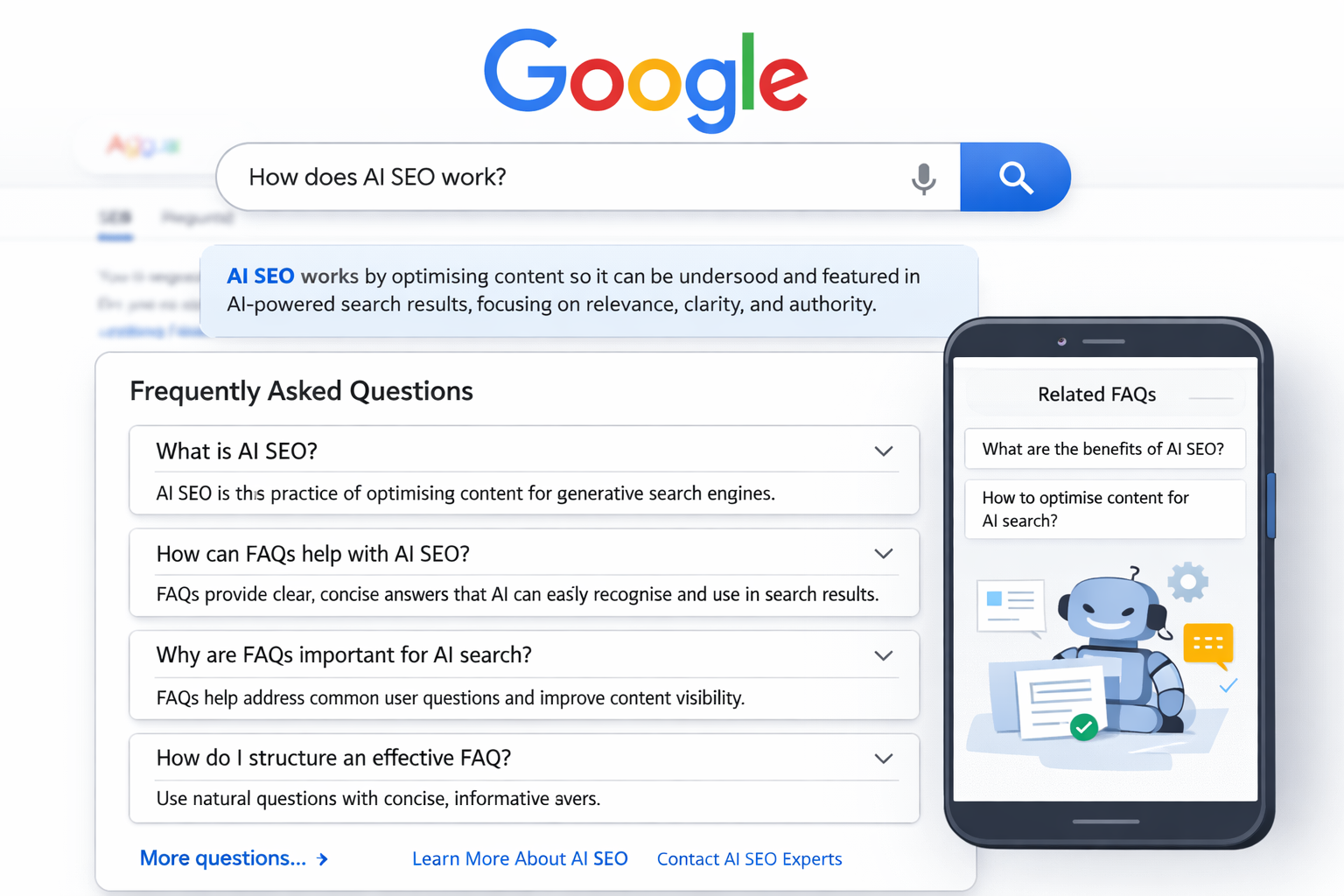
Frequently Asked Questions

How does AI SEO differ from traditional SEO in 2026?
Can I optimise for both Google SGE and ChatGPT simultaneously?
Is structured data still important in the age of AI search?
What kind of content is most likely to be used in AI answers?
How can small businesses stay competitive in AI search results?
What tools can help me monitor AI SEO performance?

More related blog

Have a Project?
Let’s talk!

Smiling young woman with long light brown hair wearing a white ribbed t-shirt and beaded necklace.
Lauren Bourne
Founder & CEO
Abstract blue circular logo with overlapping curved lines forming a stylized letter C.
Prefer email?

hello@brightkrumedia.com

Thank you! We will get back in touch with you within 48 hours.
Oops! Something went wrong while submitting the form.