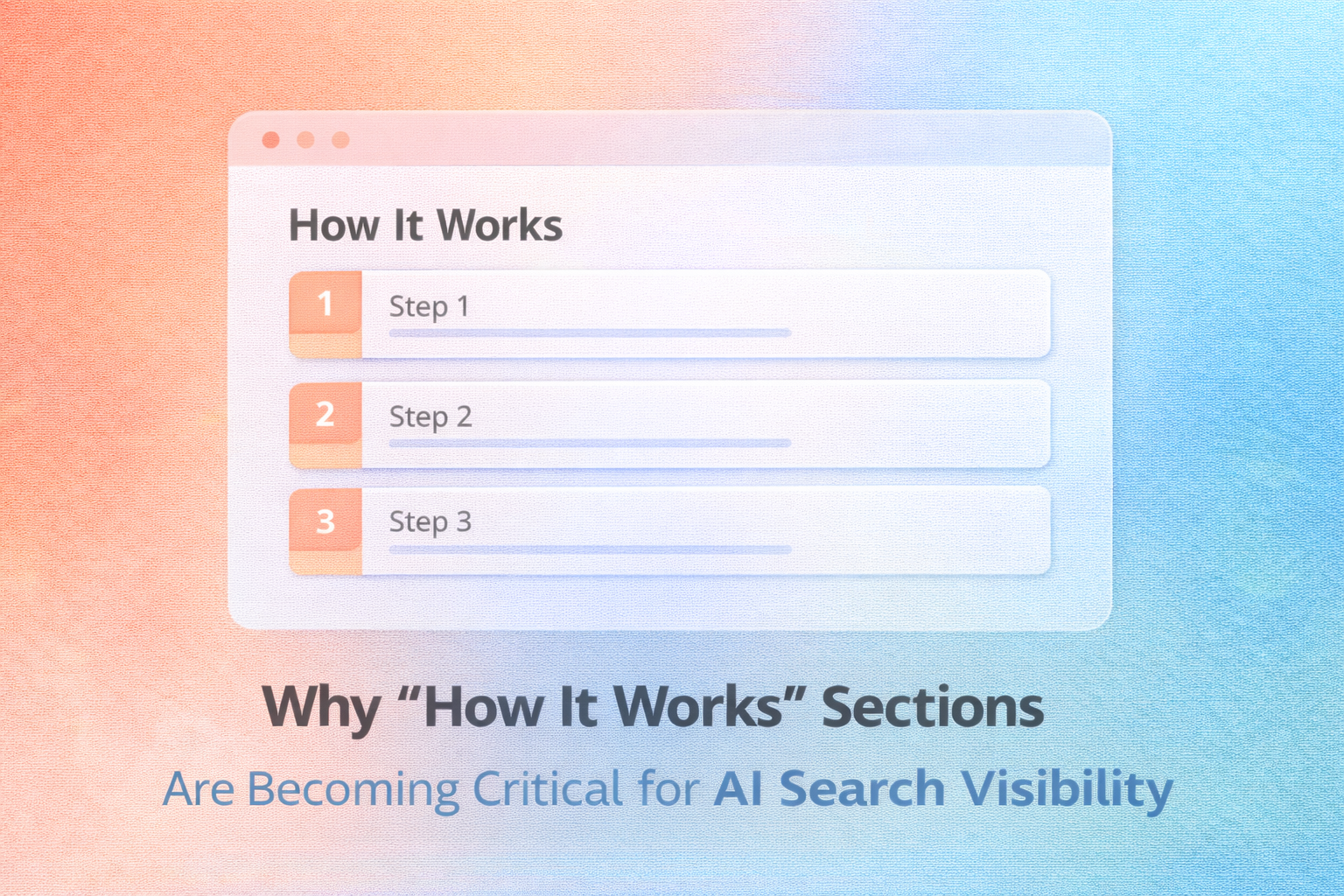
For years, “How it works” sections were treated as optional - nice to have, but often skipped if space was tight.
In the age of AI-powered search, that thinking is outdated. Clear, explicit process explanations are now one of the most effective ways to help AI systems understand what your business actually does, and whether your content is suitable to summarise, reference, or surface in search results.
This article explains why that’s the case, how AI systems interpret process based content, and how to implement “How it works” sections in a way that improves both visibility and clarity.
Humans are good at filling in gaps. If a website says: “We help businesses improve their SEO with cutting edge strategies”, most people instinctively understand that something happens behind the scenes. AI systems don’t make that leap.
They don’t assume:
Without a clearly defined process, AI models are left with outcomes but no mechanics. That makes your page harder to:
“How it works” sections solve this by turning implicit knowledge into explicit structure.
Generative search systems are designed to answer questions like:
When a page lacks a clear process explanation, AI systems have two options:
Modern AI search strongly prefers the second. Clear process sections reduce ambiguity and risk, which is why they’re disproportionately valuable in AI-generated summaries.
It’s important to separate these concepts. FAQs deal with exceptions, objections, and clarifications. “How it works” sections deal with the primary flow.
Think of it this way:
AI systems need both, but they use them differently.
When an AI model tries to understand your offering at a high level, it looks for:
That information almost never comes from FAQs alone.
Well written process sections give AI systems several things they actively look for:
1. Sequence
Step based explanations define order:
This is essential for summarisation.
2. Role clarity
AI can distinguish:
3. Scope boundaries
Clear processes implicitly define what isn’t included, which improves accuracy.
4. Intent alignment
Pages with explicit processes are easier to match to “how does X work?”-type queries.
Many service pages rely on abstract language:
These phrases are persuasive for humans, but nearly meaningless to AI systems.
From an AI perspective, they raise unanswered questions:
A “How it works” section replaces ambiguity with operational clarity.
An effective section is not long, but it is precise.
It usually includes:
Step 1: Initial assessment
We review your existing website structure and content to identify areas that limit visibility in AI-driven search results.
Step 2: Structural improvements
Key pages are restructured to improve clarity, including headings, internal linking, and process explanations.
Step 3: Content refinement
We refine language and layout to ensure information can be easily understood and summarised by AI systems.
Step 4: Ongoing review
Content is reviewed periodically to remain aligned with changes in AI-powered search behaviour.
Each step introduces:
That’s exactly what AI systems need.
Not every page needs one, but some pages absolutely do. High impact locations include:
A high level process overview helps AI understand your business model quickly.
These benefit the most. Service ambiguity is one of the biggest blockers to AI visibility.
AI systems struggle with tools unless usage is clearly explained.
Step based explanations dramatically reduce misinterpretation.
Even when businesses include “How it works” sections, they often undermine them.
Steps should describe actions, not aspirations.
Over reliance on icons, animations, or accordions can obscure meaning.
Each step should add new information.
AI systems prioritise clarity over tone.
One of the biggest advantages of this tactic is efficiency.
You don’t need:
You need:
For many websites, adding or refining a single “How it works” section can improve how AI systems interpret the entire page.
AI-powered search is not just about keywords or rankings. It’s about interpretation.
The clearer you are about:
…the easier it is for AI systems to:
“How it works” sections are one of the simplest ways to do that.
Clear process explanations are one of the most overlooked and most effective elements of AI-friendly websites.
As part of our AI SEO and generative search optimisation services, we help businesses design and implement “How it works” sections that improve clarity for both users and AI-driven search systems.
👉 Explore our AI SEO and generative search optimisation services
👉 Or contact our AI SEO specialists to review how clearly your key pages explain what you do