For years, FAQs were treated as an afterthought, a single page tucked away at the bottom of a website.
That approach no longer works. In the age of generative search, FAQs are one of the clearest, most machine readable content formats available to search engines and AI models.
Well structured FAQs now act as:
AI systems don’t “read” content the way humans do. They look for:
FAQs provide all three.
When an AI model scans a page, FAQ sections help it:
In many cases, AI-generated search responses are effectively summaries of well-written FAQs.
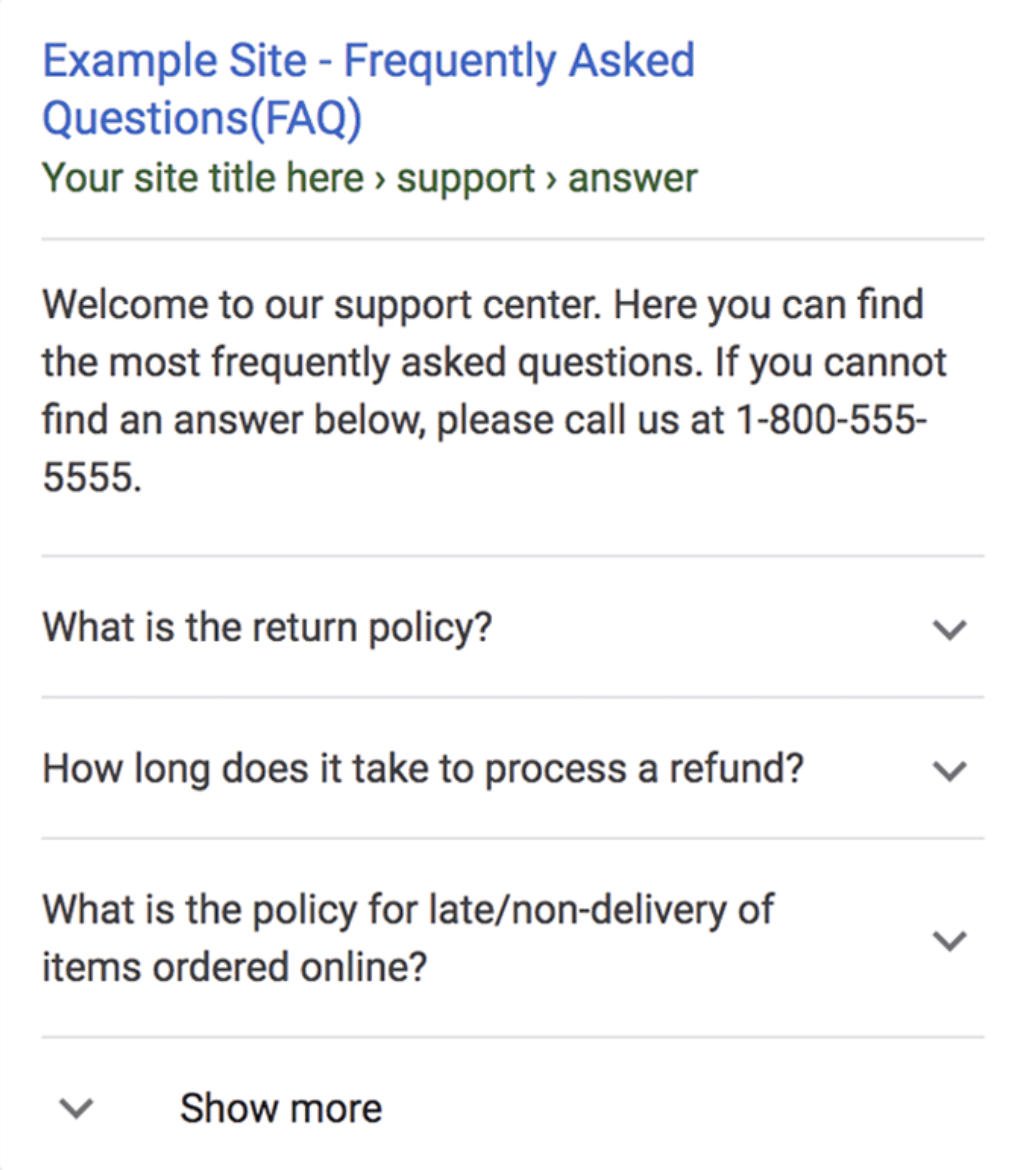
A single FAQ page is no longer sufficient. Each page targets a different intent, which means each page should answer:
This allows AI systems to match query intent to the most relevant page, not just your main FAQ hub.
AI systems prefer certainty. FAQs force clarity.
Questions naturally contain long tail, conversational queries.
Multiple FAQs reinforce subject coverage without padding content.
AI answers often resemble FAQ phrasing.
Q: Do you offer good SEO?
A: Yes, we offer great SEO services.
Q: How does AI SEO differ from traditional SEO strategies?
A: AI SEO focuses on optimising content so it can be understood, summarised, and referenced by generative search engines, rather than relying solely on keyword rankings.
Key differences:
Avoid fragments. Write how people actually ask.
Lead with a clear answer in the first sentence.
AI systems deprioritise promotional phrasing.
Use short paragraphs or bullet points where relevant.
Never reuse the same FAQs across every page.
Short answer: yes, but strategically.
FAQ schema:
However:
Schema should support, not replace, content quality.
Once implemented properly, FAQs become:
They also give businesses:
Most websites either don’t use FAQs properly o use them in ways that add no SEO value.
We help businesses design and implement AI optimised FAQ frameworks that improve clarity, authority, and visibility across every key page.
👉 Learn more about our AI SEO and generative search optimisation services
👉 Or contact our AI SEO specialists to review your current FAQ strategy

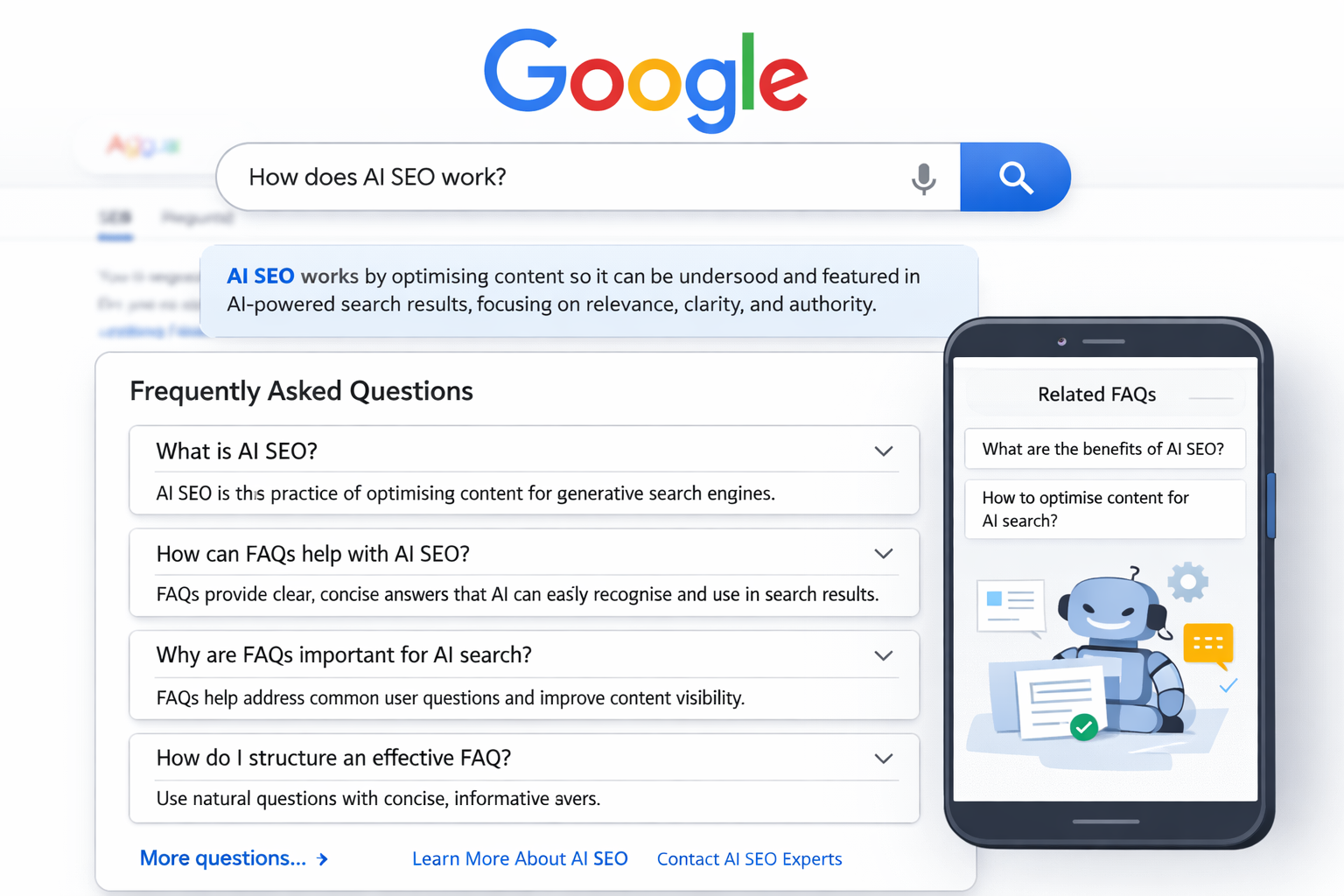
An AI optimised FAQ section goes beyond simple questions - it’s designed specifically to match how AI search tools interpret and deliver answers. This means: Using natural language, question style headings (e.g. “How do I…?”). Writing short, direct, standalone answers. Formatting for easy scanning (bullets, bold text, clear structure). Avoiding jargon and filler. Including keywords naturally in both the question and answer. This structure improves visibility in AI summaries, voice search, and Google’s Search Generative Experience (SGE).
FAQs mirror how people ask questions in real life - especially in AI chat or voice environments. When your FAQ uses the same phrasing as the user (e.g. “What is the best platform for trades websites?”), AI tools are more likely to match your content to the query. They’re also formatted in a way that’s easy to extract: a direct question, followed by a clear answer. That structure makes them a top choice for AI to cite or feature.
Yes - placing well structured FAQs at the bottom of service pages, blog posts, or landing pages can significantly improve both SEO and AI visibility. It gives you a space to expand on related subtopics, address objections, and capture long-tail searches. From an AI perspective, it also signals topical depth, increasing the likelihood of being cited in AI answers, even if the user’s query is slightly different from your page’s main topic.
They can, if they’re poorly written or duplicated across multiple pages. AI generated FAQs that are generic, repetitive, or inaccurate may hurt your site’s quality signals. To avoid this: Edit and humanise any AI generated content. Tailor questions to the exact page/topic. Focus on user intent and real life phrasing. Avoid duplicating the same FAQ block across multiple URLs. FAQs must be helpful and specific to enhance both traditional and AI SEO.
Strong FAQ topics align with user intent and common search behaviour. Some ideal themes include: Pricing, process, or timelines (e.g. “How long does a build take?”). Comparisons (e.g. “What’s the difference between Webflow and WordPress?”). Localised service details (e.g. “Do you serve Brighton & Hove?”). Definitions of niche terms (e.g. “What is schema markup?”). Trust builders (e.g. “Are your websites GDPR compliant?”). These FAQs naturally match question-based queries in both AI tools and voice search.
You can track performance using: Google Search Console: Look for growth in impressions and clicks for question based queries. Analytics: Monitor bounce rate and engagement time on pages with expanded FAQs. Rank tracking tools: See if FAQ content appears in featured snippets or People Also Ask boxes. AI search previews: Use tools or ChatGPT/Bard to test how your content is cited in answers. Over time, a well optimised FAQ section should increase visibility, expand search reach, and improve relevance in AI driven results.